- CNC & laser Cut
- Custom Vector
- Free designs
- Custom Digitizing
- Custom SVG
- CNC & laser Cut
- Custom Vector
- Free designs
- Custom Digitizing
- Custom SVG
- CNC & laser Cut
- Custom Vector
- Free designs
- Custom Digitizing
- Custom SVG

MENU
Case Study•Back to Case Studies
Thread Looping Caused by Low Tension in Embroidery
This was a 3.5-inch single-color lettering design where small thread loops appeared on top of the letter “T”, affecting the overall appearance of the stitching.
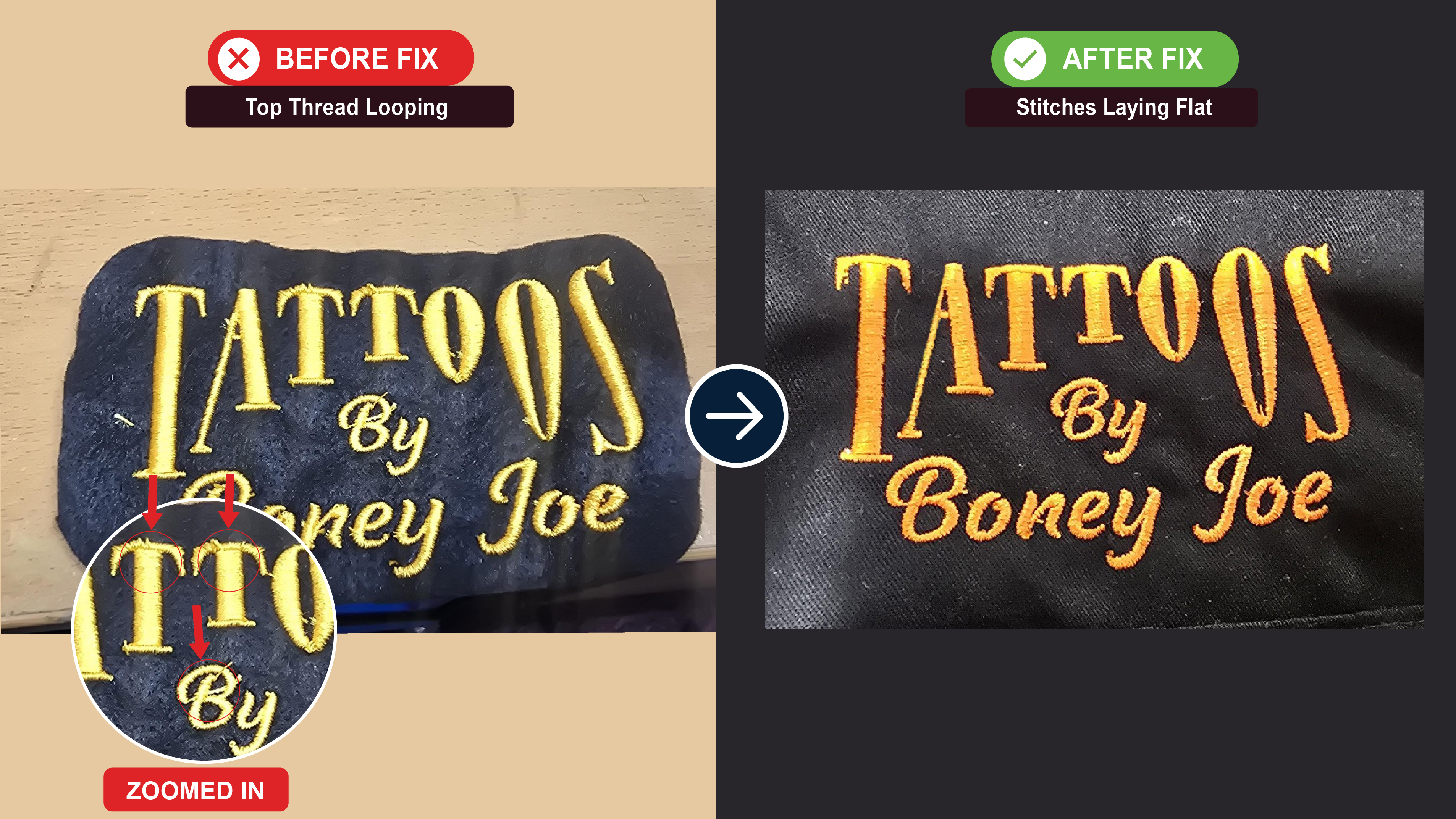
Featured image used as case study image.
The Problem
The client noticed small thread loops appearing on top of the letter “T”, and in one area there were more visible loose loops.
The rest of the design stitched well, but these loops made the letters look uneven and less clean.
The rest of the design stitched well, but these loops made the letters look uneven and less clean.
What We Found
After reviewing the stitch-out and discussing the setup with the client, we found that:
The design was digitized correctly.
The Embroidery file was suitable for clean and sharp lettering.
The issue was not coming from the design file.
From the client’s side:
They were using a test piece (felt with backing)
They had earlier issues with cheap thread breaking and fraying
To prevent breakage, the thread tension was set very low
👉 Low tension caused the top thread to sit loosely on the surface, creating visible loops
The design was digitized correctly.
The Embroidery file was suitable for clean and sharp lettering.
The issue was not coming from the design file.
From the client’s side:
They were using a test piece (felt with backing)
They had earlier issues with cheap thread breaking and fraying
To prevent breakage, the thread tension was set very low
👉 Low tension caused the top thread to sit loosely on the surface, creating visible loops
What We Did
We guided the client that this was a machine tension issue, not a digitizing issue.
Suggested steps:
Slightly increase the upper thread tension
Use good quality thread
Keep the same design file (no changes needed)
The client adjusted the tension and tested again.
Suggested steps:
Slightly increase the upper thread tension
Use good quality thread
Keep the same design file (no changes needed)
The client adjusted the tension and tested again.
Why It Worked
When thread tension is too low:
The thread does not pull properly into the fabric
It stays loose on top
This creates visible loops
By increasing the tension:
The thread pulled correctly into the fabric
Stitches tightened and laid flat
Loops disappeared
The thread does not pull properly into the fabric
It stays loose on top
This creates visible loops
By increasing the tension:
The thread pulled correctly into the fabric
Stitches tightened and laid flat
Loops disappeared
Final Results
- Stitches laid flat on the surface
- No visible thread loops
- Letters looked neat and well embroidered.
- Smooth stitch-out achieved
Client Feedback
"Definitely was thread tension this one come out much nicer"
— Joe
Project Gallery
3 images


Copyright © 2026 Las Vegas Designs USA. All rights reserved.